

I am scared.
Not of crime in the abstract. Not of some faceless monster who appears from nowhere. I am scared of the men who look ordinary. The men who have parents who love them, friends who laugh with them, neighbours who greet them, people who describe them as kind, loving, talented. The men who can walk through the world carrying one face while the person living with them knows another.
The recent murder of 25-year-old Riya Talukdar Goswami in Guwahati has left me thinking about exactly that, again.
Riya was killed on 3 September 2026. Her husband, Ramanuj Goswami, later surrendered to the police and was arrested. Her partially decomposed body was found inside their home, while her severed head had been wrapped in plastic and placed inside a refrigerator. Police also recovered a weapon believed to have been used in the killing.
And this was not the story of two strangers. They had married for love. Reports say the couple had met through Facebook and married in September 2025. They built a life together. They lived together. And yet, less than a year later, one killed the other. The details are horrifying enough without adding to them.
This alone should make us stop and think about how little we may sometimes know about what happens inside a relationship. But there is something else that disturbs me deeply.
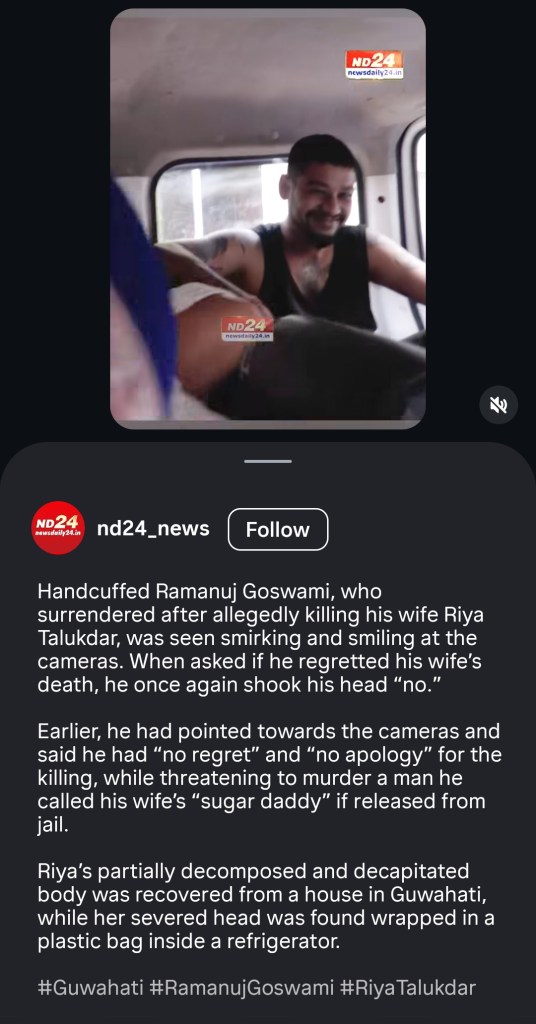
After surrendering, Ramanuj was seen smirking and smiling inside the police vehicle, even while he was handcuffed. When reporters asked whether he regretted killing his wife, he said he had “no regret” and “no apology.” He also threatened to kill a man he referred to as his wife’s “sugar daddy” if he ever got out of prison.
Think about that for a moment. A woman was dead. Her husband killed her, and then began speaking about her. He alleged that she had been involved with another man, an allegation that had not been independently established. And I cannot stop thinking about the cruelty of that. She was dead. She could no longer answer him. She could not explain herself. She could not challenge his version. She could not tell us what happened inside that house from her side of the story. Yet her name, her character and her reputation could still be dragged into the public conversation. It is one of the oldest injustices women face: even when they are no longer alive to defend themselves, the world can still be made to question them.
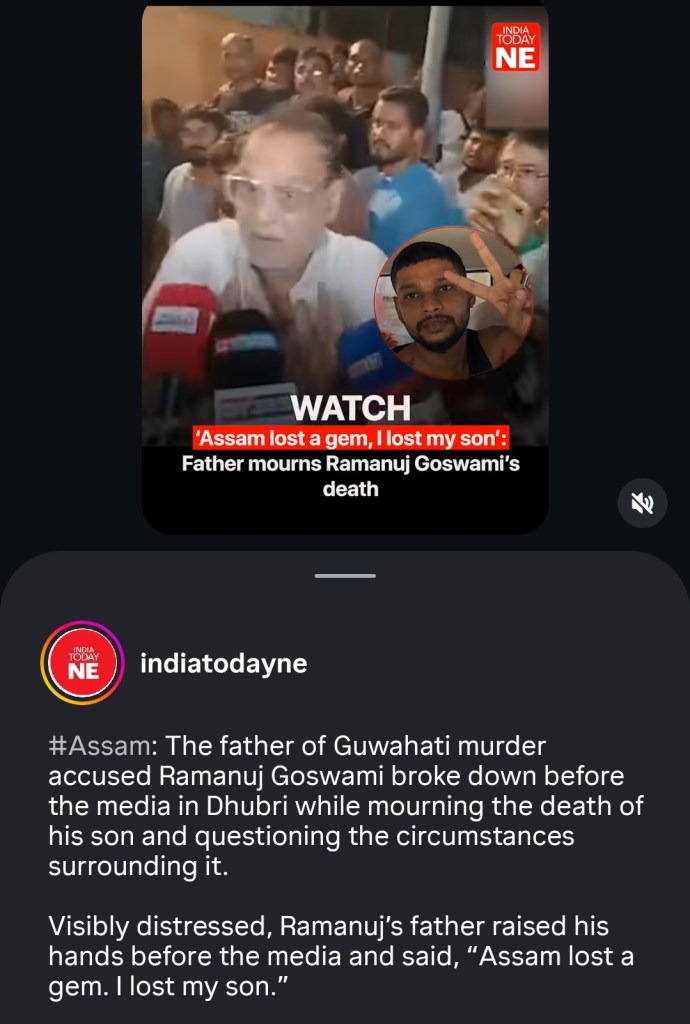
And then came the voices of the family. His father mourned his son, describing Assam as having lost a “gem”. His mother struggled to accept that Ramanuj could have committed such an act, saying that he was not “that kind of person” and describing the son she knew as respectful and values-driven.
I understand what a parent is going through. I cannot imagine the shock of discovering that the child you raised may have committed something you cannot reconcile with the person you thought you knew. But there is a question that refuses to leave me alone. What if the person you know is not the person someone’s daughter is living with? What if the man who is gentle with strangers is terrifying to the woman behind the closed door? What if the man everyone calls loving is controlling the person he claims to love? What if the man who appears generous outside the home is destroying someone’s confidence inside it? What if, every time that woman tries to tell someone, the answer she receives is: But he is such a nice person. He loves his family. He would never do that. You must have misunderstood him.
And just like that love can become dangerous. Love can make people incapable of looking directly at what is happening.
When the eyes are blind, perhaps a person can still see through the mind’s eye. But when the mind itself refuses to see, where is the hope for the person standing in front of it?
I think about Riya. I think about Maya from Sharanagati. And there are so many Riyas and Mayas—women who remain silent because they are afraid, because they love the person hurting them, because they keep hoping he will change, or because they have been made to believe that nobody will believe them anyway. Some are still trying to find the courage to speak. Some are being told that the man they fear is actually a “good man”. Some may be living in homes where everyone outside sees a loving relationship while, behind closed doors, a woman is slowly disappearing.
I won’t lie. I am scared of these men. Men who don’t merely make threats, but may eventually have the capacity to act on them. Men whose anger is dismissed as temper. Whose possessiveness is mistaken for love. Whose control is called concern. Whose jealousy is romanticised as devotion. Whose apologies become promises that are broken again. I am scared of what such men are capable of.
But I am perhaps even more troubled by what happens around them.
We often wait for visible evidence. A bruise. A broken bone. A police complaint. A hospital admission. A body. Why? Why must a woman first become a victim we can photograph before we believe that she was in danger?
If someone tells you that the person she lives with frightens her, listen.
If she says he monitors her movements, listen.
If she says he controls her money, her clothes, her friendships, her phone, her work or where she goes, listen.
If she says he threatens her when she tries to leave, listen.
You don’t have to diagnose the man. You don’t have to decide whether he is a monster. You simply have to take her fear seriously.
And to the woman who is living this reality: I know it is not always as simple as just leave. I know there may be love. There may be financial dependence. There may be children. There may be nowhere to go. There may be fear of what he will do if he finds out you are planning to leave. There may be a hundred reasons why walking out of that door is harder than people on the outside understand. But please don’t confuse your ability to understand him with your responsibility to save him. You cannot love violence out of a person. You cannot sacrifice enough of yourself to make someone choose kindness. You cannot keep enduring harm in the hope that one more chance will finally change everything. And you do not have to wait until everyone else agrees that he is dangerous.
Speak up, Maya.
Speak up, Riya.
Speak to someone you trust. Seek help. Make a safety plan. And if you decide to leave, leave as safely as you can. Don’t wait for the world to discover the man you already know. Because sometimes, by the time everyone else finally believes you, it may be too late.
And perhaps this is what we need to teach ourselves—as parents, friends, siblings, neighbours and communities: Don’t judge a man only by how he treats you. Look at how he behaves when he is angry. Look at how he responds to no. Look at how he handles rejection. Look at how he treats people who cannot do anything for him. Look at what happens when he loses control of a situation. And most importantly, if a woman tells you she is afraid of the man she lives with, don’t let his reputation speak louder than her fear.
Help Stop Violence Against Women.


Leave a comment